

You are currently being flooded with information.
Information is not hard to get and it is free everywhere!
Then, why are you having trouble making decisions?
Well, you need the skills to organize and understand the information for it to become useful to you, your business, and your clients.
You may think this is a silly thing to consider in your coaching, but having these skills is how the best coaches organize their thoughts, evaluate decisions, create their own systems, and communicate their ideas. The coaches you look up to both absorb information and arrange it in a way that gets their clients results.
If you are going to continuing education courses, you are on the right track.
If you desire to learn more in order to help your clients and athletes, you are on the right track.
Just remember that learning requires both acquiring and consolidating information.
Definitely go to courses, attend internships and mentorships, read books, read articles, listen to podcasts, and talk to colleagues to acquire information.
Then, take deliberate time to consolidate that information.
Strategies to help consolidate information include flow charts, learning maps, mind maps, and concept maps that are used as visuals to organize thoughts and make connections between ideas.
I have found mind maps to be the most useful and I want to teach you how to take advantage of this tool to improve your coaching and grow your knowledge. Here is how…
Organizing
Mind Mapping is a note-taking skill that helps you organize words, thoughts, ideas, and methodologies in the form of a diagram. You can take notes in a mind map format, practice retaining what you have learned, or use it to make connections between your currently held knowledge and experiences. It is an activity to get your thoughts out of your head and onto a piece of paper. Once your thoughts are out on paper, you will be able to build on ideas, dive deeper, and identify gaps.
How to Mind Map
You are going to use mind maps to collect your thoughts around a main topic. You should start with a thought, idea, or problem in the middle, then branch outward. I highly recommend starting with the following as a main topic, a school of thought (FRC, FMS, academic program, PRI, etc.), an internship, a mentor, a seminar or course, a struggling client, or a new client.
The goal is to visualize your knowledge. It should be a non-linear process with little emphasis on identifying relationships between thoughts in the beginning. Mind maps provide the opportunity to explore your creativity and ask yourself questions.
I have listed some prompting questions below, to help you explore the answers within your mind map.
Main Topic: Word (example: ‘Strength’, ‘Balance’, ‘Propulsion’)
- How do you define it?
- Why do you believe that to be true?
- Can it have another definition?
- How do you know a client or athlete possesses it?
Main Topic: New Client
- What are some perceived expectations?
- Where do your decisions come from?
- How do you know you are making changes?
Main Topic: Seminar or Course (example: Mike Robertson’s Complete Coaching course)
- How has the information influenced you as a person and how you think about training, fitness, assessments, etc.?
- How can you use information from assessments to make decisions? If you are not making decisions from the information gathered, should you use it for an assessment?
- What are some general curiosities the information sparked?
- What are some elements that inform your programming and decisions?
If you want a comprehensive resource to help build out your mind mapping, download the free Advanced Mind Mapping Prompting Questions document HERE and get step-by-step questions for different main topics.
Once you have multiple mind maps, you can then start to find similarities between maps. These commonalities are going to help you identify your beliefs and principles.
Here are some tips to keep in mind:
- Expect to start messy!
- When you feel stuck, step away for a few hours or days and come back to it
- Push yourself to define terms, for example, if you write the word ‘Strength’ or ‘Balance’, define what those words mean to you
- Explore both application and understanding
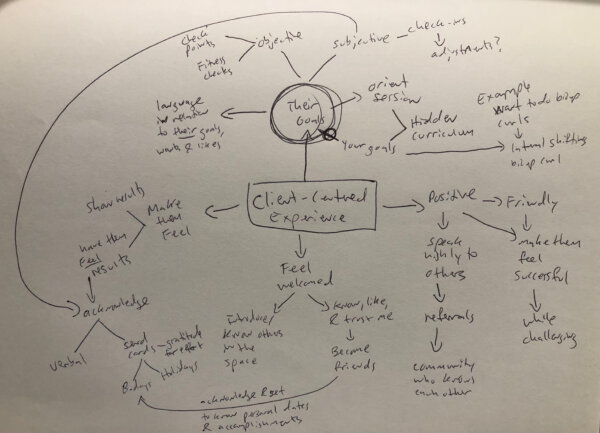
Example: Rough draft mind map for ‘Client-Centered Experience’. I started with just a pen and piece of paper and I expected it to be messy. Later, I can return to the mind map and add color and add how to implement the ideas.
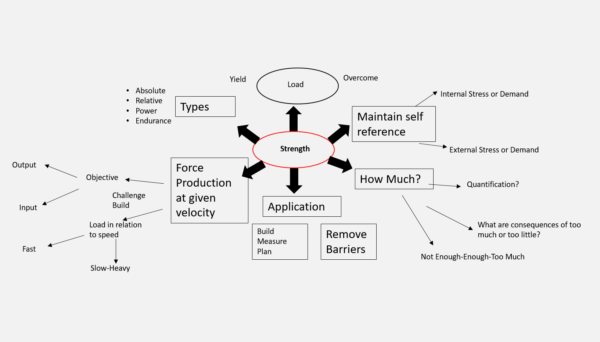
Example: Above is a rough draft of a mind map for the word ‘Strength’. I put the main topic in the middle (can be image or words), I wrote out all related areas and ideas, then tried to break down everything I wrote.
Understanding
Mind mapping improves the DEPTH of your understanding. I am sure you will know a lot of the ‘what’ and the ‘how’ in your mind maps. But the ‘why’ is where you can really explore and identify knowledge gaps. For example, the ‘what’ of a squat is knowing what a squat pattern is, the ‘how’ would be teaching the squat technique, and the ‘why’ would be the consequences, benefits, and intent of the squat pattern.
Through mind mapping, you will also learn how to connect thoughts and ideas. When you learn a new piece of information, in order to make it more meaningful, you can attach it to something you currently understand. An example of this is making a mind map of your currently held understanding of biomechanics, and comparing it to a mind map relating to a new course that you attended. This is a way to connect new information with previously held ideas, beliefs, and methodologies. In this manner, mind mapping brings information together in an associative way to layer your depth of understanding.

Example of a ‘Client-Coach Relationship’ Mind Map.
Building A Model
A model is an all encompassing mind map that will be in a diagram or flowchart format. It represents how your process works. It guides you in regards to how you do things, what you are trying to do, and how you will know when you have obtained the goal. A model diagram needs to communicate a direction and process. Your model should also indicate points of assessment, decision making steps, and feedback loops.
Here are a few model examples from members of the Strategy Course Group Classroom cohort:

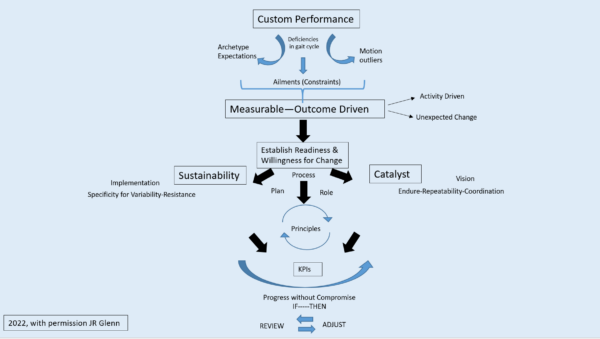

Once models and principles have been established, you move on to implementing and communicating them within
- business websites
- conversations with clients
- intake processes
- marketing language
- programming templates
- assessment processes
- standards of care
- and exercise selection processes
Identify Gaps in Knowledge
Another tool that mind mapping and model development provides is the ability to identify gaps in knowledge. A gap is a hole between what is known and what ought to be known. The best way to identify gaps is by reviewing your mind maps. Look for where you have question marks, where you stopped in your thought process, and where you couldn’t make connections. You can also review failures, feedback, outcomes, and curiosities.
The best prompting question to identify gaps in knowledge is,
‘what are you getting frustrated with?’
The next step is to use those gaps to direct future learning strategies and resource selection. If you want the ultimate fitness and performance resource guide, check out the Resource Road Map to help plan your learning. When you acquire new information, the process with mind mapping and consolidation starts again. However, once you go through the process of determining what is important to you, your ability to filter new information improves. You will be better able to determine what is useful to you, your business, and your clients.
Resources:
- How to Create Mind Maps & Diagram Models Video and Advanced Mind Mapping Prompting Questions Document
- The MBT Strategy Course Group Classroom is a 8-week live course that helps you consolidate your knowledge and experiences into an efficient process and more results for your clients. The next group starts February 14th, 2022. Join the Group HERE.
More Resources:
- Mind Mapping: Improve memory, concentration, communication, organization, creativity, and time management by Kam Knight
- Coggle for free mind mapping and flow chart software
- Lucid for online mind mapping software
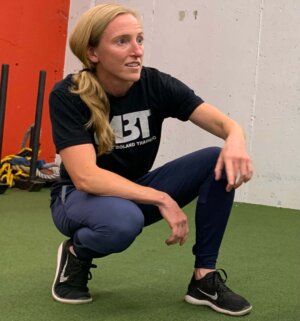 About the Author: Dr. Michelle Boland
- Owner of Michelle Boland Training, LLC
- www.michelleboland-training.com
- Past D1 Strength and Conditioning Coach at Northeastern University (Boston, MA)
- PhD. Exercise Physiology and M.S. Strength and Conditioning at Springfield College
- Follow on Instagram @dr.michelleboland
- MBT Strategy Course Group Classroom